
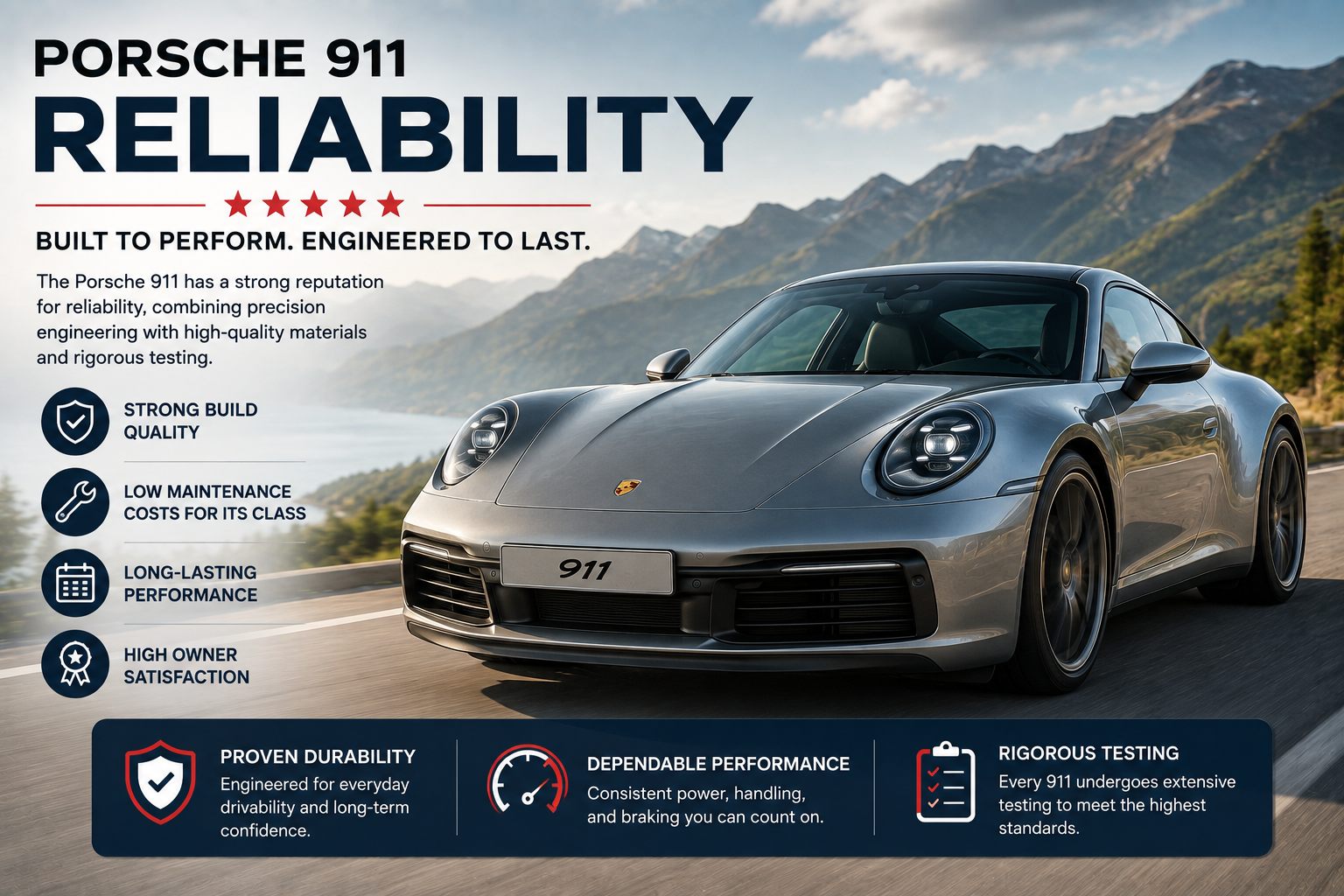
A generation-by-generation ownership guide to engine risks, PDK vs. manual, maintenance costs, recalls, longevity, and the pre-purchase checks that matter most
Porsche 911 reliability is difficult to summarize with one score because a 1999 Carrera, a 2011 Carrera S, a 2018 Carrera GTS, and a 2026 Carrera share the same model name but not the same engine architecture, electronics, transmission technology, or failure risks. Some older 911s have specific engine issues that deserve a specialist inspection. Later cars generally avoid those famous problems, but their repair costs can still be high because the parts, labor, tires, brakes, and electronics belong to a premium sports car.
For a U.S. buyer in 2026, the most useful question is not simply, “Is a Porsche 911 reliable?” It is, “Which generation am I buying, what has already been serviced, and how expensive is the worst plausible failure on that specific car?” A well-maintained 911 can be a dependable daily driver or long-term weekend car. A neglected example with incomplete records can become expensive very quickly, even if the model year has a strong reputation.
| The short answer
Modern Porsche 911s are generally durable when serviced correctly, and the 2026 model scores strongly in short-term owner quality data. The biggest used-car reliability concerns are concentrated in specific earlier generations, especially non-Turbo 996 and 997.1 Carreras with M96/M97 engines. For most shoppers, condition and documented maintenance matter more than mileage alone. |
Key Takeaways
- D. Power gives the 2026 Porsche 911 a 91/100 Quality & Reliability score, but that should be read as a current-owner quality indicator rather than proof of 10- or 15-year durability.
- The 996 generation and early 997.1 Carreras deserve extra scrutiny for intermediate-shaft bearing and cylinder bore concerns. Turbo and GT3 models use different engine families and should not be grouped with ordinary Carreras.
- The 2009-2012 997.2 is a popular lower-risk used choice because its 9A1 direct-injection engine eliminated the serviceable IMS-bearing architecture used in earlier Carrera engines.
- The 991 and 992 generations generally have fewer famous catastrophic engine issues, but cooling-system parts, electronic systems, active engine mounts, batteries, PDK servicing, and expensive wear items still matter.
- The 2025-and-newer 992.2 GTS T-Hybrid is too new for a meaningful long-term reliability verdict. Its performance is proven, but durability over high mileage is not yet established.
- Porsche new-car warranty coverage is four years or 50,000 miles. Porsche Approved CPO cars add meaningful protection and can be a smart way to reduce repair-cost risk on a newer used 911.
- A Porsche-specialist pre-purchase inspection is one of the best reliability investments you can make. For higher-risk M96/M97 cars, that inspection may need a borescope, oil-filter inspection, over-rev report, leak check, and verification of IMS history.
- A reliable 911 is not necessarily a cheap 911. RepairPal currently lists average annual repair and maintenance cost around $1,072 across model years, but individual Porsche repairs can run into several thousand dollars and dealer service can cost substantially more.
Why Do Porsche 911 Reliability Ratings Seem to Contradict Each Other?
Reliability scores measure different things. A new-car owner survey may capture software glitches, fit-and-finish complaints, and early mechanical faults. A repair-cost database may penalize the car because a single Porsche-specific repair is expensive even if failures are not frequent. Neither approach tells you whether a 20-year-old flat-six has bore scoring.
For example, J.D. Power currently rates the 2026 Porsche 911 at 91/100 for Quality & Reliability. That is a strong result. RepairPal, by contrast, rates the 911 lower because its methodology weighs repair cost and severity across multiple model years. Consumer Reports does not publish a statistically confident detailed reliability history for every recent 911 model year because the sample size is relatively small.
The practical lesson is to use ratings as context, not as a substitute for generation-specific research. A 2026 score tells you very little about a 2004 Carrera, and an average repair-cost figure tells you very little about whether a carefully maintained 2016 Carrera has been reliable for its owner.
Reliability Risk Map by Porsche 911 Generation
| Generation | Approx. U.S. Years | Reliability View | Main Things to Check | Used-Buyer Take |
| 996 | 1999-2005 | Highly condition-dependent | IMS history, bore scoring, RMS, cooling system, AOS | Great value only with specialist inspection |
| 997.1 | 2005-2008 | Condition-dependent | Bore scope, engine number/IMS type, leaks, suspension | Buy carefully, especially Carrera S |
| 997.2 | 2009-2012 | Lower-risk older choice | PDK service, cooling, age-related rubber and suspension | One of the strongest classic-modern compromises |
| 991.1 | 2012-2016 | Generally strong | Cooling system, engine mounts, service history, PDK, borescope if warranted | Good daily-driver generation |
| 991.2 | 2017-2019 | Generally strong | Turbo cooling hardware, PDK service, mounts, electronics | Modern performance with established track record |
| 992.1 | 2020-2024 | Strong but electronics-heavy | Battery health, software, recalls, cooling, center-lock cars | Excellent if records and campaigns are current |
| 992.2 | 2025-present | Too new for long-term verdict | Software, recalls, new hybrid hardware on GTS, battery care | Buy on warranty rather than assumed longevity |
Is the 996 Porsche 911 Reliable?
The 996 can be reliable, but it is the generation where generic reassurance is least useful. Non-Turbo Carrera models use the M96 engine family, and those engines are associated with the intermediate-shaft bearing issue that became one of the most discussed Porsche problems of the water-cooled era.
The exact IMS bearing design changed during production. Early cars generally used a dual-row bearing, while many 2000-2005 cars used a smaller single-row bearing. Late 2005 and later M96/M97 applications moved to a larger non-serviceable bearing. The details matter enough that engine number and existing service documentation can be more useful than model year alone.
For a detailed technical explanation of the bearing types and affected engines, see LN Engineering’s current IMS bearing guide.
IMS is not the only 996 concern. Cylinder bore scoring can affect non-Turbo Carrera engines, especially later 3.6-liter cars. Other age-related issues include air-oil separators, rear main seal leaks, water pumps, radiators packed with debris, coolant expansion tanks, worn suspension components, window regulators, and aging interior electronics.
| Important exception
Do not apply ordinary Carrera IMS advice to every 996. Turbo and GT3 versions use the Mezger-based engine family and have a different reliability profile. A buyer should research the exact engine and trim rather than treating all 996s as mechanically identical. |
Is the 997.1 Better, or Does It Have the Same Problems?
The 997.1 improved the cabin, styling, and overall refinement, but early Carrera engines are still closely related to the M96/M97 architecture. That means the model is not automatically free of the concerns that follow the 996.
Bore scoring is the larger pre-purchase concern on many 997.1 Carreras, particularly the 3.8-liter Carrera S. A warm-engine ticking sound from one bank, increased oil use, sootier exhaust tips, or metallic material in the oil filter can justify a deeper inspection, but the absence of symptoms does not prove the bores are perfect.
A proper borescope inspection can be worthwhile before buying a high-value 997.1. The inspection needs to be performed and interpreted by someone who regularly works on Porsche flat-six engines because superficial cylinder marks are not the same as advanced scoring.
Why Is the 997.2 Often Recommended as a Reliable Used 911?
The 2009 model-year update is important because Porsche introduced the 9A1 direct-injection engine family for Carrera models. The earlier intermediate-shaft bearing architecture disappeared, which removes one of the most famous failure concerns from the shopping checklist.
The 997.2 is not maintenance-free. These cars are now well over a decade old, so age matters. Engine and transmission mounts, suspension arms, dampers, coolant components, air-conditioning systems, seals, brakes, and electrical modules can all require attention. First-generation PDK cars also need documented transmission servicing and a careful road test.
Still, for a buyer who wants the smaller dimensions and analog feel of the 997 without the same IMS anxiety as an earlier Carrera, the 997.2 remains one of the most attractive reliability-oriented choices in the used 911 market.
How Reliable Are the 991.1 and 991.2 Generations?
The 991 generation moved the 911 into a more modern era with a longer wheelbase, more electronics, electric power steering, and broader use of PDK. The basic engine architecture is also more mature than the M96/M97 era.
On 991.1 Carreras, buyers should still look for clean service records, stable oil consumption, quiet cold and warm operation, cooling-system health, and evidence that the car has not spent years doing only very short trips. Bore scoring is discussed among specialists and owners on some naturally aspirated 991.1 engines, but there is no robust public failure-rate dataset that supports treating every 991.1 as high risk. A borescope may be sensible when symptoms, climate history, oil consumption, or a specialist inspection gives a reason to investigate.
The 991.2 switched Carrera models to smaller turbocharged flat-six engines. These cars have built a generally good reliability reputation, but complexity moved elsewhere. Cooling circuits, turbo hardware, vacuum controls, active engine mounts, sensors, and PDK components can be expensive when they fail. A full service history remains more valuable than a low odometer with long gaps between maintenance visits.
How Reliable Is the 992 Porsche 911?
The 992 has strong early reliability indicators. Its engines and PDK transmission are evolutions of established Porsche designs, and the current 2026 model receives a 91/100 Quality & Reliability score from J.D. Power.
The 992 also illustrates how modern reliability is changing. A car can have a mechanically healthy engine and transmission while still requiring dealer visits for cameras, software, battery management, sensors, or driver-assistance systems. In late 2025, Porsche issued a large U.S. recall covering certain 2020-2025 911s and other Porsche models because a rearview or surround-view camera image may fail to display correctly. A software update is the remedy for affected vehicles.
Certain 911 variants equipped with center-lock wheels were also recalled for potentially out-of-specification center-lock components. The campaign involved specific vehicles rather than every 911, which is why a VIN-based recall search is more useful than a generic model-year list.
Before buying any used 911, enter the exact VIN in the NHTSA recall lookup and verify that all open campaigns have been completed. Recall repairs are performed free of charge by the manufacturer.
What About the New 992.2 T-Hybrid?
The updated 992.2 generation adds more electronics and, in the Carrera GTS, Porsche’s T-Hybrid system. It uses a 3.6-liter flat-six, an electrically assisted turbocharger, a motor integrated into the PDK housing, a 400-volt electrical system, and a compact high-voltage battery.
The system is impressively integrated, but no one can honestly provide a long-term reliability verdict yet. The earliest customer cars have not accumulated the age or mileage needed to know how the hybrid turbo, power electronics, high-voltage battery, and related cooling systems behave over a decade.
For a 2025 or 2026 GTS buyer, factory warranty coverage matters more than internet predictions. Porsche covers new vehicles for four years or 50,000 miles, and the first scheduled maintenance visit is included. The long-term reliability answer will become clearer only after a larger population has accumulated meaningful mileage.
Is PDK More Reliable Than a Manual Transmission?
Both can be durable. The reliability difference is mainly about what happens when something eventually wears or fails.
Manual 911
A manual gearbox is mechanically simpler from the owner’s perspective, but clutch life depends heavily on use. A car that has been launched repeatedly, tracked, or driven by an inexperienced owner can need a clutch sooner than a gently driven highway car. A high clutch engagement point, slipping under load, gear grinding, or difficult shifts deserve investigation.
PDK 911
Porsche Doppelkupplung is exceptionally quick and has proven durable in many high-mileage cars, but it requires the correct fluid and filter services. Problems can involve sensors, control hardware, clutches, hydraulic components, or internal mechanical parts. The repair bill can be much higher than a normal clutch replacement if major work is needed.
The best used-car choice is therefore not automatically manual or PDK. It is the transmission with documented service, clean operation, no fault history, and the driving experience you actually want.
How Expensive Is Porsche 911 Reliability?
A useful distinction is reliability versus ownership cost. A 911 can go years without a major failure and still cost far more to maintain than a mainstream sedan because wear items and specialist labor are expensive.
RepairPal currently lists average annual repair and maintenance cost for the Porsche 911 at about $1,072 across model years. That number should be treated as a broad database average, not a budget for every owner. It can understate the cash-flow reality of a low-mileage sports car because expensive services, tires, brakes, batteries, suspension work, and major repairs often arrive in uneven years rather than as a predictable monthly expense.
| Ownership Item | Reliability Impact | Why It Matters |
| Oil and annual service | Preventive | Regular servicing catches leaks, debris, fluid changes, and developing faults early |
| Tires | Safety and drivetrain health | Staggered high-performance tires are costly and alignment matters |
| Brakes | Wear item, not a reliability failure | Porsche brake hardware is powerful but expensive, especially PCCB |
| Cooling system | Can prevent larger failures | Water pumps, valves, radiators, and coolant leaks should not be ignored |
| Battery and charging | Important on low-use cars | Modern 911 electronics dislike long periods with a weak battery |
| PDK service | Preventive | Correct scheduled fluid and filter work protects an expensive transmission |
| Pre-purchase inspection | Risk reduction | Can identify leaks, over-revs, crash repairs, bore concerns, and deferred maintenance |
How Many Miles Can a Porsche 911 Last?
There is no responsible single-mileage expiration point for a 911. Age, maintenance, engine family, climate, storage, oil-change history, track use, accident repairs, and how often the car reaches full operating temperature all matter.
High mileage by itself is not a reason to reject a car. A regularly driven 911 with 80,000 miles, complete records, fresh fluids, healthy compression, clean bores, and recent suspension work may be a safer purchase than a 25,000-mile example that sat for long periods and received sporadic maintenance.
For older cars, evidence of proactive maintenance is especially valuable. Hoses, seals, mounts, dampers, control arms, engine accessories, and electrical components age even when the odometer barely moves.
Which Porsche 911 Generations Are the Best Reliability Bets?
Best older balance: 997.2
The 997.2 is attractive because it combines the compact, classic-modern 911 shape with the 9A1 engine that removed the earlier Carrera IMS-bearing design. Age-related repairs are now unavoidable on some cars, but the generation has a cleaner engine-risk profile than the 996 and 997.1 Carreras.
Best modern used balance: 991.2
A well-maintained 991.2 gives buyers modern crash protection, strong performance, mature PDK technology, and an engine family that has been on the road long enough to have a meaningful service history. Turbocharging adds complexity, but these cars are less defined by a single famous catastrophic engine issue.
Best newest choice: 992.1 with warranty or CPO coverage
For buyers who want current technology and lower age-related risk, a 2020-2024 992.1 with complete records is compelling. Porsche Approved CPO cars are particularly attractive because the program includes a 111-point inspection and at least 24 months of warranty coverage in the U.S. after the applicable warranty starting point.
Higher-risk bargain: 996 or 997.1 bought correctly
These cars can still be excellent ownership experiences, and many have covered substantial mileage without catastrophic failure. They simply require more technical due diligence. A low purchase price is not a bargain if the engine needs a five-figure rebuild shortly afterward.
What Should a Porsche 911 Pre-Purchase Inspection Include?
- Cold start and fully warm engine evaluation. Listen for abnormal ticking, smoke, rough running, and unusual mechanical noise.
- Diagnostic scan for stored and pending fault codes, plus over-rev data on models where the information is available.
- Engine and transmission leak inspection from underneath, not only from the top of the engine bay.
- Cooling-system pressure and visual inspection, including radiators, coolant pipes, water-pump area, and debris trapped in front heat exchangers.
- Oil-filter inspection for metallic or plastic debris when the model and service timing justify it.
- Borescope inspection for 996 and 997.1 Carreras when appropriate, especially if there are symptoms or the buyer wants maximum risk reduction.
- Verification of IMS replacement documentation on serviceable M96/M97 cars. Do not accept a verbal claim without an invoice or identifiable hardware.
- PDK or manual transmission operation from cold and at full temperature.
- Brake rotor, pad, tire, wheel, and alignment inspection. Uneven tire wear can expose suspension or accident-repair issues.
- Suspension and active engine-mount check, including PASM and PDCC components where fitted.
- Convertible-top or Targa mechanism operation on open-roof cars.
- Paint-depth and underbody inspection for accident repairs, track damage, curb strikes, and improper jacking.
- VIN recall search and verification that completed campaigns appear in the service history.
| Do not use a generic inspection shop for a high-value 911
A normal pre-purchase inspection may confirm tires, brakes, and fluid leaks but miss Porsche-specific engine, over-rev, PDK, bore, center-lock, or active-chassis issues. For an older 911, choose an independent Porsche specialist that is not financially connected to the seller whenever possible. |
Does Porsche CPO Make a 911 More Reliable?
Certification does not change the mechanical design, but it changes the financial risk. Porsche Approved vehicles are inspected to factory standards, must meet age and mileage eligibility rules, and receive warranty coverage that can absorb the cost of many covered component failures.
For buyers considering a newer 991 or 992, paying more for a properly documented CPO car can make sense if the price difference is smaller than the potential cost of one major electrical, PDK, suspension, or engine-related repair. As always, read the actual warranty terms and exclusions rather than assuming every wear item is covered.
Frequently Asked Questions
Are Porsche 911s reliable enough to daily drive?
Yes. Many modern 911s are used as daily transportation, and regular use can be better for seals, batteries, and mechanical systems than months of inactivity. The owner still needs to budget for premium tires, scheduled service, brakes, and occasional high-cost repairs.
What is the most reliable Porsche 911 generation?
There is no universally proven winner, but the 997.2, 991.2, and well-maintained 992.1 are strong lower-risk choices for different budgets. The 997.2 is especially popular among buyers who want an older car without the same IMS-bearing concern as earlier Carrera engines.
What Porsche 911 years should you be careful with?
Non-Turbo 996 and 997.1 Carreras deserve more intensive engine inspection because of M96/M97 IMS and bore-scoring concerns. That does not make every car bad. It means purchase history and specialist inspection are more important.
Do 997.2 Porsche 911s have IMS bearing problems?
The 2009-2012 997.2 Carrera uses the 9A1 engine, which eliminated the earlier intermediate-shaft bearing arrangement associated with the well-known M96/M97 IMS issue.
Are Porsche PDK transmissions reliable?
PDK has generally proven durable, including in high-performance use, but it is complex and expensive. Service records matter. A used car should shift smoothly at low speed, under full throttle, and when fully warm, without fault messages or abnormal hesitation.
Is a low-mileage 911 more reliable?
Not automatically. Low mileage is attractive, but long storage periods can create battery, seal, tire, fluid, and corrosion issues. A moderately driven car with excellent records may be mechanically healthier than a garage queen with deferred maintenance.
Is the 2026 Porsche 911 reliable?
Early indicators are strong. J.D. Power rates the 2026 911 at 91/100 for Quality & Reliability, and the core flat-six and PDK hardware are highly evolved. Long-term data for the newest 992.2 versions, especially the GTS T-Hybrid, is not mature enough for a 10-year reliability conclusion.
The Bottom Line: Reliability Depends More on Generation and History Than the Badge
The Porsche 911 is not an unreliable sports car by default. In fact, newer generations have strong early quality scores, and many well-maintained examples deliver years of dependable use. What makes the model intimidating is the cost of getting the wrong car wrong.
For a lower-risk older purchase, the 997.2 is one of the most convincing choices. The 991.2 offers a strong modern balance, and the 992.1 is attractive for buyers who want current technology and can keep warranty or CPO coverage in the equation. The 996 and 997.1 can be excellent values, but they should be purchased with specialist engine knowledge rather than optimism.
A reliable 911 purchase therefore starts before the test drive. Identify the exact engine family, read the maintenance file, verify recalls, inspect the car from cold to fully warm, and pay for a Porsche-specific PPI. The best car is rarely the one with the fewest miles. It is the one whose history gives you the fewest unanswered questions.