
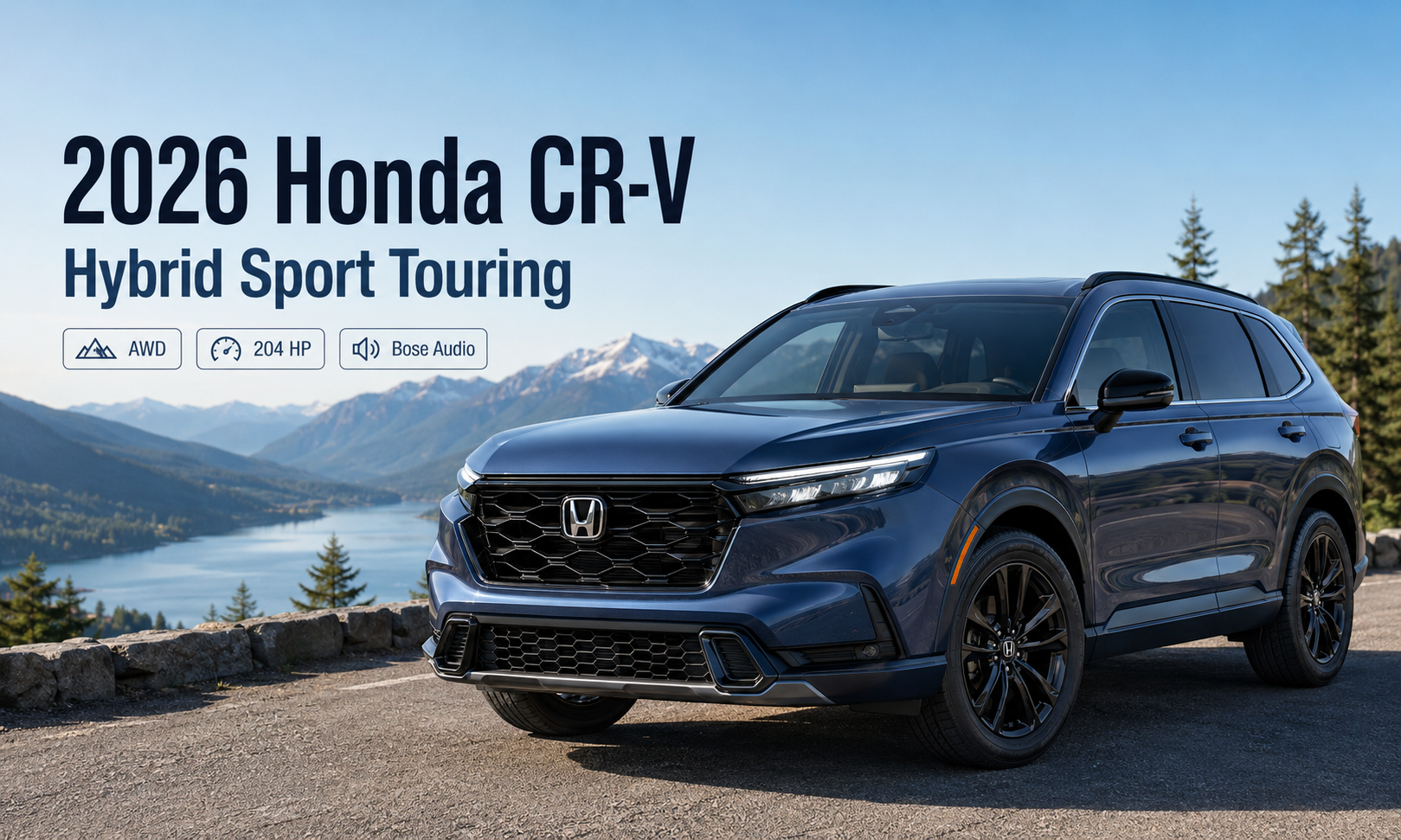
A top-trim decision guide covering price, AWD, hybrid efficiency, cabin upgrades, real-world performance, cargo space, towing, and the reasons to choose Sport Touring over Sport-L.
The 2026 Honda CR-V Hybrid Sport Touring is not the version to buy simply because it sits at the top of the lineup. It makes sense when you specifically value its standard all-wheel drive, quieter premium equipment mix, Bose audio, Google built-in, hands-free tailgate, heated steering wheel, and 19-inch wheels enough to pay more than a Sport-L Hybrid.
That is the useful way to evaluate this CR-V. The hybrid powertrain itself does not become more powerful when you move up to Sport Touring. You still get 204 combined horsepower. The difference is how much comfort, technology, traction hardware, and convenience Honda bundles around that powertrain.
For 2026, Honda also updated the CR-V Hybrid lineup with a standard 9-inch touchscreen, wireless Apple CarPlay and Android Auto, wireless phone charging, and improved low-speed traction management on AWD models. Car and Driver’s 2026 CR-V Hybrid review gives the model a 10/10 rating and reports that the Sport Touring reached 60 mph in 7.1 seconds while returning 35 mpg in its 75-mph highway test.
| KEY TAKEAWAYS
· Honda lists the 2026 CR-V Sport Touring Hybrid at $42,550 before a $1,450 destination charge, bringing the starting total to $44,000 before tax, registration, accessories, and dealer fees. · The two-motor hybrid system produces 204 hp and sends power through standard Real Time AWD on Sport Touring. · EPA fuel economy is 40 mpg city, 34 mpg highway, and 37 mpg combined for AWD hybrid models such as Sport Touring. · Car and Driver measured 35 mpg at a steady 75 mph and 0 to 60 mph in 7.1 seconds. · Sport Touring adds features that Sport-L shoppers may care about most: Bose premium audio, Google built-in, hands-free tailgate, heated steering wheel, 19-inch wheels, and standard AWD. · The hybrid can tow up to 1,000 pounds when properly equipped, so it is better suited to small utility or recreational trailers than heavy towing. |
Question 1: Are You Paying for More Performance or More Equipment?
Mostly more equipment. The 2026 Sport Touring uses the same basic 204-hp two-motor hybrid architecture found in the other CR-V Hybrid trims. Honda pairs a 2.0-liter Atkinson-cycle four-cylinder with electric motors, and the system is tuned for smooth, efficient everyday driving rather than hot-hatch acceleration.
The Sport Touring is AWD only. Honda’s Real Time AWD system can send torque to the rear axle when conditions call for it, and the 2026 update adds enhanced low-speed traction management below roughly 9 mph. That change is aimed at situations such as snow, loose surfaces, and low-traction starts rather than aggressive off-roading.
Car and Driver recorded a 7.1-second 0-to-60-mph time. That is quick enough for confident highway merging and passing, but the CR-V Hybrid’s stronger selling point is how naturally the electric motors fill in low-speed torque. Around town, it generally feels more responsive than the horsepower figure alone suggests.
If you move from Sport-L to Sport Touring, therefore, do not expect a faster powertrain. Expect a more complete version of the same hybrid CR-V.
Question 2: What Does the 2026 Sport Touring Actually Cost?
Honda currently lists the Sport Touring Hybrid at $42,550 MSRP. Add the $1,450 destination charge and the starting figure becomes $44,000 before tax, title, registration, premium-paint charges, dealer accessories, or dealer-specific pricing.
Honda’s current 2026 CR-V build and price tool lists the following starting MSRPs for the hybrid trims:
| 2026 Hybrid Trim | Starting MSRP | Drivetrain Context |
| Sport Hybrid | $35,630 | FWD standard, AWD available |
| Sport-L Hybrid | $38,725 | FWD standard, AWD available |
| TrailSport Hybrid | $38,800 | AWD standard |
| Sport Touring Hybrid | $42,550 | AWD standard |
The Sport Touring’s sticker is $3,825 above the front-drive Sport-L starting price, but that comparison slightly exaggerates the real equipment gap because Sport Touring already includes AWD. Once a Sport-L is configured with AWD, the price difference narrows. This is why shoppers should compare actual dealer window stickers rather than only the trim-page base prices.
The practical value question becomes whether the Sport Touring exclusives are worth the remaining premium after you match drivetrains.
Question 3: Which Sport Touring Features Are You Really Buying?
The Sport Touring is the CR-V Hybrid for buyers who want the most factory-installed convenience and infotainment equipment without moving into a luxury brand. The additions are not dramatic individually, but together they make daily ownership feel more polished.
- Standard Real Time AWD rather than optional AWD.
- 19-inch gloss-black alloy wheels instead of the 18-inch wheels used on lower hybrid trims.
- Bose premium audio system.
- Google built-in for native Google Maps, voice assistance, and compatible apps.
- Hands-free access power tailgate.
- Heated leather-wrapped steering wheel.
- Leather-trimmed seats with orange stitching.
- 2-inch digital instrument cluster.
- Wireless Apple CarPlay and Android Auto, wireless phone charging, and front/rear USB ports.
- Parking sensors plus the standard Honda Sensing driver-assistance suite.
The 2026 update matters because some features that previously helped distinguish expensive trims, including the 9-inch touchscreen and wireless smartphone integration, are now standard more broadly. That makes Sport Touring less about simply getting the bigger screen and more about its premium audio, Google integration, AWD, tailgate, steering-wheel heat, and trim-specific details.
How Efficient Is the 2026 CR-V Hybrid Sport Touring?
Because Sport Touring comes with AWD, its EPA rating is 40 mpg city, 34 mpg highway, and 37 mpg combined. Front-wheel-drive CR-V Hybrid models are rated higher at 43 city, 36 highway, and 40 combined.
This is a useful tradeoff to understand. AWD costs roughly 3 mpg in the combined EPA rating compared with the most efficient front-drive hybrid. In return, Sport Touring gives you additional traction capability and the more powerful feeling of Honda’s AWD hybrid calibration without changing the 204-hp combined rating.
Real-world highway performance looks encouraging. Car and Driver recorded 35 mpg on its 75-mph highway test, 1 mpg better than the Sport Touring’s 34-mpg EPA highway figure. Its measured 75-mph highway range was about 490 miles.
Drivers who spend most of their time in urban and suburban traffic may see the hybrid’s strongest advantage because regenerative braking and electric operation can help most in lower-speed use. Long, fast interstate trips reduce that advantage because the gasoline engine runs more continuously.
What Is the Cabin Like on Long Trips?
The Sport Touring’s cabin is one of the strongest reasons to choose the CR-V over flashier rivals. The design is simple, visibility is good, and physical climate-control knobs remain easy to use while driving. The honeycomb-style dash trim keeps the vents visually tidy without turning the dashboard into a screen wall.
Front-seat comfort is good, and rear-seat passengers benefit from generous space. The backrest reclines, and the rear floor is relatively family friendly. The CR-V still feels like a compact SUV from the outside, but the interior packaging is closer to what buyers expect from a larger vehicle.
The Sport Touring also avoids the common top-trim mistake of fitting an enormous wheel package. Its 19-inch wheels are larger than lower trims but still leave enough tire sidewall for reasonable ride comfort. The ride can feel firmer over sharp impacts than some competitors, yet it remains controlled and easy to live with.
How Much Cargo Space Do You Get?
Hybrid packaging slightly reduces cargo volume compared with some gas-only CR-V configurations, but the Sport Touring remains one of the more useful compact SUVs for family gear.
Car and Driver measured about 35 cubic feet behind the rear seats and 72 cubic feet with the rear seats folded in its Sport Touring test vehicle. In its standardized luggage test, the CR-V Hybrid held 11 carry-on suitcases behind the rear seat and 29 with the second row folded.
The low load floor and wide opening are more important in everyday use than the headline cubic-foot number. Strollers, grocery bins, luggage, sports gear, and pet crates fit without awkward loading angles. The hands-free tailgate on Sport Touring is especially useful when approaching the vehicle with both hands occupied.
Can the CR-V Hybrid Sport Touring Tow?
Yes, but only light trailers. Honda rates the hybrid CR-V to tow up to 1,000 pounds when it is equipped with the proper towing accessories and the load is within all vehicle limits.
That is enough for a small utility trailer, lightweight personal-watercraft setup, or certain compact recreational trailers, but it is not enough for a typical travel trailer. Buyers who tow frequently should also pay attention to the vehicle’s door-jamb payload label because passengers, cargo, accessories, and tongue weight all count against the vehicle’s allowable load.
If towing is a major reason for buying a compact SUV, the CR-V Hybrid should be treated as a light-duty tow vehicle rather than a downsized truck substitute.
Does the Sport Touring Feel Different From the TrailSport?
Yes, even though both use the same 204-hp hybrid system and standard AWD. The TrailSport is aimed at drivers who value rough-road confidence. It uses 18-inch wheels with all-terrain tires and rugged styling details. Those tires help on loose surfaces but reduce fuel economy to 38 mpg city, 33 highway, and 35 combined.
The Sport Touring instead uses road-oriented 19-inch tires, achieves 37 mpg combined, and emphasizes quietness, premium audio, technology, and everyday comfort. In Car and Driver testing, the TrailSport reached 60 mph in 7.3 seconds, slightly slower than the Sport Touring’s 7.1 seconds, and its cabin measured a little louder at highway speed.
Choose TrailSport for gravel roads, snow, campsites, and a tougher tire package. Choose Sport Touring if most of your miles are on pavement and you want the nicer daily-driver experience.
Sport Touring vs Sport-L: Where Is the Better Value?
| Feature | Sport Touring | Sport-L |
| Hybrid output | 204 hp | 204 hp |
| AWD | Standard | Available |
| Wheels | 19-inch gloss black | 18-inch gloss black |
| Leather seats | Standard | Standard |
| 9-inch touchscreen | Standard | Standard |
| 10.2-inch digital cluster | Standard | Standard |
| Bose premium audio | Standard | No |
| Google built-in | Standard | No |
| Hands-free tailgate | Standard | Power tailgate |
| Heated steering wheel | Standard | Not the defining standard feature |
Sport-L is the rational value pick. It already gives you leather, the 9-inch touchscreen, wireless phone features, power front seats with driver memory, parking sensors, a moonroof, and the same hybrid powertrain. If you do not care about Bose audio, Google built-in, hands-free tailgate operation, the heated steering wheel, or the Touring-specific wheels, Sport-L can save meaningful money.
Sport Touring becomes easier to justify if you were going to add AWD to Sport-L anyway and you value the extra technology every day. Buyers who keep vehicles for many years may also prefer having those features factory-integrated rather than adding aftermarket audio or navigation solutions later.
What Are the Sport Touring’s Weak Points?
No compact SUV is perfect, and the top CR-V Hybrid has several tradeoffs that matter more at a roughly $44,000 starting total with destination.
- It is not especially quick. A 7.1-second 0-to-60 time is adequate, not sporty.
- AWD fuel economy is lower than the 40-mpg combined rating of front-drive CR-V Hybrids.
- The 19-inch wheels look better but can cost more to replace tires for than 18-inch setups.
- The hybrid tow rating is only 1,000 pounds.
- The interior is thoughtfully designed but not as overtly luxurious as some similarly priced near-luxury alternatives.
- You pay for a bundle of convenience features rather than a stronger powertrain.
Those are not reasons to avoid the Sport Touring. They are reasons to make sure you are buying it for the correct advantages.
Who Should Buy the 2026 CR-V Hybrid Sport Touring?
Sport Touring is best for a buyer who wants to keep one compact SUV for many years and would rather pay once for a complete specification than spend time choosing individual options.
- You want standard AWD for snow, rain, steep roads, or frequent low-traction conditions.
- You drive enough miles for hybrid fuel savings to matter.
- You appreciate premium audio and want Google Maps and Google services integrated into the vehicle.
- You regularly use the cargo area and will benefit from a hands-free tailgate.
- You value a heated steering wheel in cold climates.
- You want the most upscale CR-V Hybrid without moving to an Acura or another premium badge.
If your priorities are simply hybrid efficiency and cabin space, Sport or Sport-L deliver most of the CR-V’s fundamental strengths for less. If your priority is tougher tires and rough-road ability, TrailSport is the more focused choice.
Frequently Asked Questions
How much is the 2026 Honda CR-V Hybrid Sport Touring?
Honda lists it at $42,550 MSRP. Add the current $1,450 destination charge and the starting total is $44,000 before taxes, registration, premium paint, accessories, and dealer fees.
Is the 2026 CR-V Sport Touring Hybrid AWD?
Yes. Real Time AWD is standard on Sport Touring for 2026.
What MPG does the 2026 CR-V Sport Touring get?
As an AWD hybrid, it is rated at 40 mpg city, 34 mpg highway, and 37 mpg combined. Car and Driver recorded 35 mpg on its 75-mph highway test.
How much horsepower does the CR-V Sport Touring Hybrid have?
The two-motor hybrid system produces 204 combined horsepower.
How fast is the 2026 CR-V Hybrid Sport Touring?
Car and Driver measured 0 to 60 mph in 7.1 seconds.
Does the Sport Touring have Google built-in?
Yes. Google built-in is one of the features that separates Sport Touring from the Sport-L Hybrid.
Can the CR-V Hybrid tow a trailer?
Yes, but the maximum is 1,000 pounds when properly equipped. It is intended for light towing.
Is Sport Touring worth it over Sport-L?
It is worth considering if you already want AWD and value Bose audio, Google built-in, the hands-free tailgate, heated steering wheel, and Touring-specific 19-inch wheels. If those features do not matter, Sport-L is the stronger value.
Final Verdict: Buy Sport Touring for the Complete Package, Not the Badge
The 2026 Honda CR-V Hybrid Sport Touring is easy to recommend, but it is not automatically the smartest CR-V for every buyer. Its 204-hp hybrid system, roomy cabin, 37-mpg combined AWD rating, standard driver-assistance technology, and useful cargo area are strengths shared with less expensive versions of the same vehicle.
What Sport Touring adds is completeness. Standard AWD, Bose audio, Google built-in, a heated steering wheel, hands-free tailgate, 19-inch wheels, leather seating, parking sensors, and the larger digital cluster make it feel like a CR-V that needs little or nothing added after purchase.
For shoppers who want maximum value, Sport-L remains the trim to beat. For shoppers who want the most polished factory version and plan to use its added features every day, the Sport Touring earns its premium. The key is to compare actual AWD-equipped Sport-L dealer stickers against Sport Touring stickers, then decide whether the remaining price gap is worth the convenience features to you.
Pricing, features, fuel-economy figures, and specifications were checked against current U.S. Honda and Car and Driver information available in August 2026. MSRP, destination charges, dealer pricing, equipment, and EPA ratings can vary by configuration or change over time.