
A 17-year-old used-car playbook covering current value, CVT risk, steering-lock problems, S vs. SV, fuel economy, recalls, and the inspection that matters most
The 2009 Nissan Maxima is now old enough that buying one has almost nothing to do with the glowing road tests it received when new. The 290-horsepower V6 is still appealing, the cabin can still feel more upscale than the price suggests, and current market values put a typical example around the $4,000 mark. But a 17-year-old Maxima should be judged like an aging performance sedan, not like cheap transportation with a Nissan badge.
That means service history matters more than trim, a clean cold start matters more than shiny paint, and the continuously variable transmission deserves a careful road test even though the 2009 Maxima does not show the same complaint pattern as some later Nissan CVT models. There is also one generation-specific problem every shopper should know: the electronic steering column lock can fail and prevent the car from starting.
| The 2026 verdict in one sentence
A well-maintained 2009 Maxima can still be an entertaining and comfortable $4,000 used sedan, but only buy one after verifying the steering-lock history, testing the CVT from cold to fully warm, checking the front suspension recall by VIN, and budgeting for age-related repairs that can easily equal a large percentage of the car’s value. |
Key Takeaways
- Kelley Blue Book currently puts a typical 2009 Maxima at about $3,925 for an S and $4,275 for an SV when bought from a dealer in good condition, with private-party values around the mid-$3,000 range.
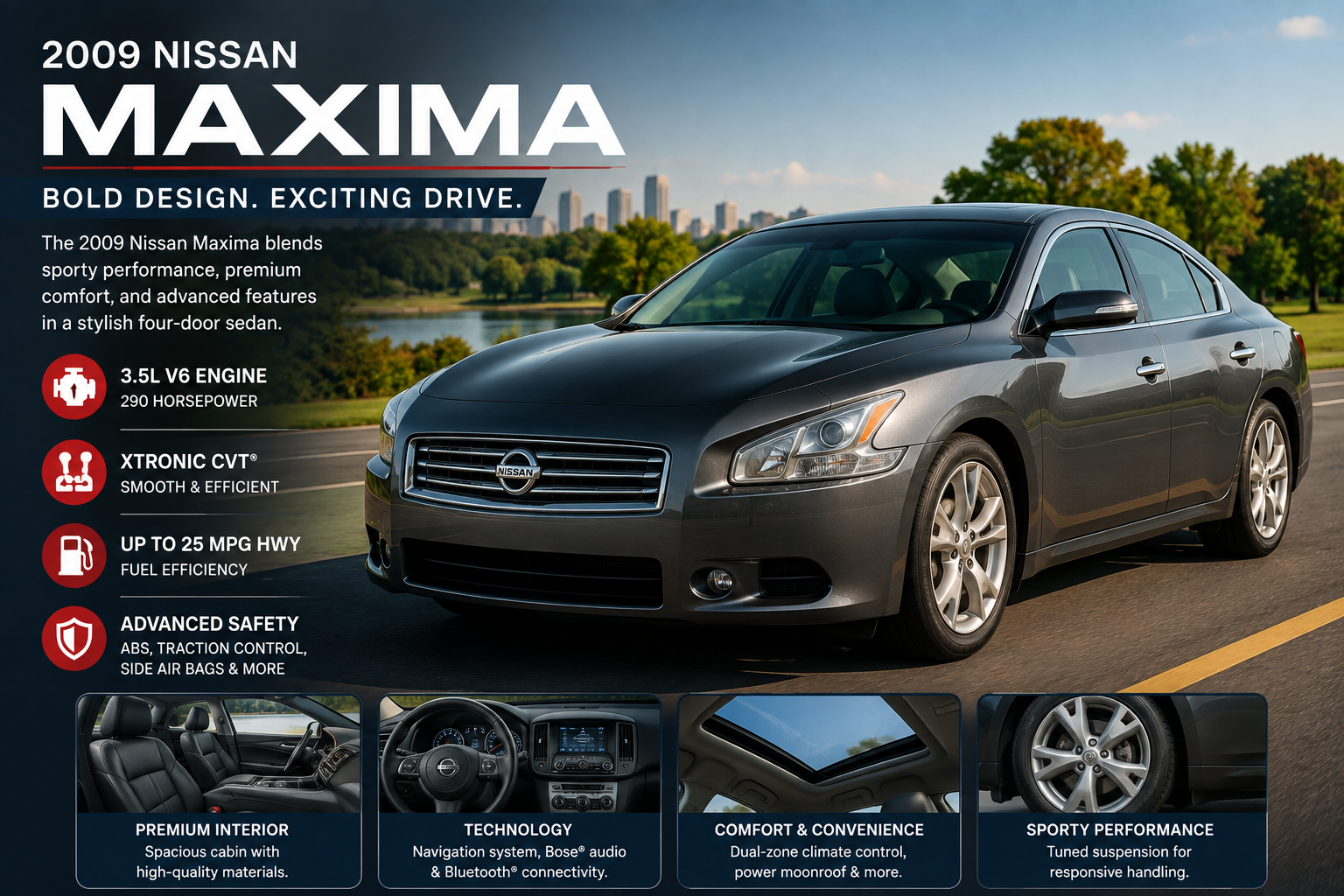
- Every 2009 Maxima uses a 3.5-liter VQ35DE V6 with 290 hp and 261 lb-ft of torque, front-wheel drive, and Nissan’s Xtronic continuously variable transmission.
- EPA fuel economy is 19 mpg city, 26 highway, and 22 combined, and premium fuel is recommended.
- The CVT should not be condemned automatically, but on a car this old its fluid history and behavior during an extended road test are critical because transmission replacement can exceed the value of the vehicle.
- Certain 2009 and 2010 Maximas were covered by Nissan voluntary service campaign PC516 for an electronic steering column lock that could fail and prevent the engine from starting. The campaign is no longer active, so buyers should verify whether the work was completed.
- A federal safety recall, NHTSA 09V-358, covered certain 2009 and 2010 Maximas for front strut insulators that could crack and affect vehicle stability.
- The SV is the better-equipped trim, but condition is more important than options. A clean S with service records is a better purchase than a neglected SV with navigation, leather, and a panoramic roof.
- D. Power currently shows an 82/100 Quality & Reliability score for the 2009 Maxima, while KBB owners rate reliability highly. Those scores do not remove the need for a pre-purchase inspection on a 17-year-old car.
The Price Reality: What Is a 2009 Maxima Worth Now?
The Maxima has reached the stage where condition can move the price more than trim. Kelley Blue Book’s late-July 2026 national averages list the S at about $3,925 and the SV at about $4,275 as typical dealer fair-purchase prices in good condition. Private-party values are roughly $3,350 for the S and $3,650 for the SV.
| 2009 Trim | Original MSRP | 2026 Dealer Fair Purchase | 2026 Private Party |
| 3.5 S | $29,985 | $3,925 | $3,350 |
| 3.5 SV | $36,530 | $4,275 | $3,650 |
Current value source: Kelley Blue Book 2009 Nissan Maxima pricing. KBB notes that mileage, condition, location, and equipment can move an individual vehicle well above or below these national averages.
At this price level, paying an extra $1,000 for the right car can be smarter than buying the cheapest listing. A $3,000 Maxima that immediately needs tires, brakes, suspension work, and a steering-lock repair can become more expensive than a $4,500 example with records and recent maintenance.
The Mechanical Snapshot Before You Start Shopping
| Specification | 2009 Nissan Maxima |
| Engine | 3.5-liter naturally aspirated V6 |
| Output | 290 hp at 6,400 rpm |
| Torque | 261 lb-ft at 4,400 rpm |
| Transmission | Xtronic continuously variable transmission |
| Drivetrain | Front-wheel drive |
| EPA fuel economy | 19 city / 26 highway / 22 combined mpg |
| Fuel tank | 20.0 gallons |
| Recommended fuel | Premium |
| Trunk | 14.2 cu ft |
| Seats | 5 |
When new, this combination was one of the Maxima’s biggest strengths. Car and Driver praised the redesigned 2009 model for restoring a more sporting identity and giving the flagship Nissan a clear 20-hp advantage over the V6 Altima of the era. That basic VQ35 V6 still gives the car strong passing power today.
Risk Map: What Can Actually Turn a Cheap Maxima Into an Expensive One?
| Area | Risk Level | What to Look For | Why It Matters |
| Electronic steering lock | High if history unknown | No-start history, Intelligent Key warning, campaign paperwork | Failure can leave the car unable to start |
| CVT | High-cost inspection item | Whine, shudder, delay, surge, overheating, fluid history | Replacement can exceed the car’s value |
| Front suspension | Medium | Clunks, uneven tire wear, recall completion | Age and recall history both matter |
| Engine | Medium | Oil leaks, rough idle, smoke, warning lights, mounts | V6 is durable but age-related repairs add up |
| Cooling / A/C | Medium | A/C output, fans, coolant condition, overheating signs | Neglect can create expensive secondary damage |
| Electronics | Medium | Windows, locks, seats, roof, audio, key functions | SV option content can be costly to repair |
Risk No. 1: The Electronic Steering Column Lock
This is the most distinctive 2009 Maxima issue because it can turn an otherwise running car into a no-start vehicle. Nissan issued voluntary service campaign PC516 for certain 2009-2010 Maximas and Altimas. The original electronic steering column lock could malfunction after the vehicle was parked and prevent the engine from starting.
The campaign replaced the original lock with a revised electronic steering column box. Nissan’s bulletin explained that the issue did not affect steering or engine operation while the car was already running. However, the campaign was later closed, so a 2026 buyer should not assume Nissan will repair an untouched car for free.
| What to ask the seller
Ask whether the steering-lock campaign was completed and request an invoice or dealer history. If the seller has no records, call a Nissan dealer with the VIN and ask whether PC516 appears in the service history. A history of intermittent no-starts or an Intelligent Key warning deserves extra caution. |
Risk No. 2: Does the 2009 Maxima Have a Bad CVT?
The useful answer is more nuanced than the internet shorthand that every Nissan CVT is bad. Complaint databases show far fewer transmission complaints for the 2009 Maxima than for some later Nissan models that became central to CVT class-action settlements. That does not make an original 17-year-old transmission low-risk.
The Maxima’s CVT works under a powerful V6 and relies on the correct fluid, temperature control, hydraulic pressure, sensors, and internal components. A poorly maintained unit can fail expensively, and even a healthy one may not feel like a conventional stepped automatic. You therefore need to distinguish normal CVT behavior from warning signs.
What should a healthy CVT feel like?
- Immediate engagement into Drive and Reverse without a long pause.
- Smooth acceleration without repeated surging or shuddering.
- No high-pitched whine that becomes dramatically louder after the car is fully warm.
- No sudden loss of acceleration after a long highway drive or steep climb.
- No transmission warning light or check-engine light.
- Predictable engine speed when the accelerator is held steady.
What CVT history should you want to see?
Service records showing CVT-fluid maintenance with the correct Nissan-specified fluid are valuable. At this age, the exact interval matters less than proof that the transmission has not been ignored for 100,000-plus miles. If the owner cannot document any CVT service, treat that as a pricing and risk factor rather than assuming the fluid was changed.
During a pre-purchase inspection, a technician can also scan the transmission control module for stored or pending codes even if the dashboard has no warning light. That is especially important because a cheap used car can be cleared of codes shortly before it is listed for sale.
Risk No. 3: Front Strut Insulator Recall
NHTSA safety recall 09V-358 covered certain 2009 and 2010 Nissan Altima and Maxima cars because the upper front strut insulators may have been manufactured out of specification. A cracked insulator could allow the strut rod to move out of position and affect vehicle stability.
The original remedy replaced both front strut insulators at no charge on affected vehicles. A car being 17 years old does not tell you whether the repair was completed, because recall status is VIN-specific.
Before purchase, enter the VIN at the NHTSA recall lookup and ask a Nissan dealer to confirm completed campaigns and recalls in the service history.
S or SV: Which 2009 Maxima Should You Buy?
The S and SV share the same engine, CVT, front-wheel-drive layout, and basic body structure. The difference is equipment. SV models could be optioned into a near-luxury sedan with leather, a dual-panel panoramic roof, upgraded audio, navigation, heated and cooled seats, power steering-column adjustment, and other features.
Those features were impressive in 2009 and still make an SV feel special at a $4,000 price point. They also create more things to break. A failed power shade, seat motor, sunroof mechanism, amplifier, navigation controller, or steering-column motor can be hard to justify repairing on a low-value car.
| Buyer Priority | Choose S | Choose SV |
| Lowest ownership complexity | Better | More equipment can mean more repairs |
| Leather / luxury features | Limited | Better choice |
| Performance | Same 290-hp V6 | Same 290-hp V6 |
| Current price difference | Small | Small |
| Best rule | Buy on condition | Buy on condition and working options |
Is the 2009 Maxima Reliable Enough to Daily Drive?
It can be, but reliability at this age is individual-car reliability rather than model-year reliability. J.D. Power currently rates the 2009 Maxima at 82/100 for Quality & Reliability, and Kelley Blue Book owner reviews also score the car strongly. Those historical owner results are encouraging, especially for the VQ35 engine.
What those scores cannot capture is the condition of a specific 150,000-mile car after 17 summers, winters, owners, batteries, tires, suspension parts, and maintenance decisions. A well-documented Maxima can remain useful transportation. A neglected example can turn into a sequence of $400 to $1,500 repairs that quickly exceed what you paid for the car.
Age-Related Problems to Check Even If the Car Runs Well
- Engine and transmission mounts: Watch for excessive vibration at idle, a thump when shifting into Drive or Reverse, and engine movement under load.
- Oil leaks: Inspect valve-cover areas, the underside of the engine, and the driveway beneath the car. Small leaks are common on older vehicles, but active dripping deserves attention.
- Power steering system: Listen for pump whine and inspect hoses and fittings for leaks. Heavy steering or low fluid should not be dismissed as normal age.
- Suspension and wheel bearings: Clunks, humming, wandering, uneven tire wear, or vibration can indicate worn struts, bushings, bearings, tie rods, or control-arm components.
- Cooling system: Verify stable temperature, clean coolant, proper fan operation, and no sweet smell or residue around hoses and the radiator.
- Air conditioning: A/C repairs can become expensive on an old sedan. Test it at idle and while driving, not only for 30 seconds in the seller’s driveway.
- Electrical accessories: Cycle every window, lock, seat switch, mirror, sunroof, climate-control mode, key fob, audio source, and dashboard display.
- Tires and brakes: Four matching quality tires with even wear are a good sign. Cheap mismatched tires or a steering wheel that shakes during braking can indicate deferred maintenance.
The 45-Minute Test Drive That Can Save You Thousands
A five-minute spin around the block is not enough for a 2009 Maxima. Some transmission, cooling, wheel-bearing, and suspension problems appear only after the car is fully warm.
- Start the car completely cold. Listen for rattles, rough idle, belt noise, exhaust leaks, and abnormal smoke.
- Let it idle with the A/C on. Watch the temperature gauge and verify the fans cycle normally.
- Shift slowly from Park to Reverse to Drive. Note any long delay, bang, or severe vibration.
- Drive gently first. Check whether the CVT responds smoothly at light throttle.
- Use a highway ramp and perform a firm acceleration run. The engine should pull cleanly without shuddering or losing power.
- Drive at highway speed for at least 15 to 20 minutes if possible. Listen for CVT whine, wheel-bearing hum, wind noise, and vibration.
- Brake from 50 to 60 mph with moderate pressure. The car should remain straight and the steering wheel should not shake.
- Make several tight low-speed turns. Listen for clunks, clicking, binding, and power-steering noise.
- After the drive, leave the engine running, inspect underneath for fresh leaks, then restart the car after a short hot soak.
- Scan all modules for codes before money changes hands, even if no warning lights are illuminated.
How Much Should You Budget After Buying One?
The purchase price should not be your entire budget. On a 17-year-old performance-oriented sedan, a $1,000 to $2,000 repair reserve is a more realistic starting point than spending every available dollar on the vehicle itself.
| Expense | Why It Matters | Buying Strategy |
| Pre-purchase inspection | Finds leaks, suspension wear, codes, prior repairs | Treat as mandatory |
| Fluids and filters | Establishes a maintenance baseline | Budget immediately if records are weak |
| Tires | Affects braking, wet grip, and ride | Four matching tires are worth paying more for |
| Brakes / suspension | Wear is normal at this age | Use inspection results in negotiation |
| Unexpected electrical repair | Old luxury features can fail | Keep a cash reserve |
| CVT failure reserve | Low probability can still mean high cost | Walk away from symptoms rather than pricing the repair later |
Does the 2009 Maxima Still Feel Fast?
By 2026 standards, 290 horsepower is no longer extraordinary, but the Maxima remains quick enough to feel strong in normal traffic. The V6 delivers smooth midrange power and the front-wheel-drive layout makes acceleration easy to access without the complexity of an all-wheel-drive system.
The car’s character is more grand touring than true sports sedan. The CVT keeps the engine near its power band under hard acceleration, but there is no manual transmission and no rear-wheel-drive balance. That does not erase the appeal. For roughly $4,000, the Maxima still offers significantly more power and cabin richness than many economy cars available at the same price.
What Does It Cost to Fuel?
EPA ratings are 19 mpg city, 26 highway, and 22 combined. KBB lists premium fuel as recommended. That means fuel cost is one of the hidden differences between a cheap Maxima and a similarly priced compact car.
At 10,000 miles per year and 22 mpg, the car would use about 455 gallons annually. A driver covering 15,000 miles would use about 682 gallons at the same combined rating. Actual consumption will vary with traffic, tire pressure, maintenance condition, climate, and how often the V6 is used aggressively.
Who Should Buy a 2009 Nissan Maxima in 2026?
- Buy one if you want a powerful, comfortable sedan for very little money and can keep a repair reserve.
- Prioritize a car with extensive service history, a smooth warm CVT, and proof the steering-lock campaign was addressed.
- Choose an S if simplicity and condition matter more than luxury features.
- Choose an SV if all major options work and the car has equally strong maintenance history.
- Consider one as a second car or budget commuter if you have access to a trusted independent mechanic.
Who Should Skip It?
Skip the 2009 Maxima if an unexpected $1,000 repair would create a financial emergency. A low purchase price does not create low repair prices. Parts and labor are still based on a relatively complex V6 sedan, not on its current market value.
It is also a poor choice if the seller cannot explain the CVT history, the car has intermittent starting problems, multiple warning lights are illuminated, or the test drive reveals transmission shudder, major suspension noise, overheating, or evidence of neglected maintenance.
Frequently Asked Questions
How much is a 2009 Nissan Maxima worth in 2026?
Kelley Blue Book currently lists typical dealer fair-purchase prices around $3,925 for an S and $4,275 for an SV in good condition. Private-party values are roughly $3,350 to $3,650, but mileage, condition, location, and equipment can change the price substantially.
How much horsepower does a 2009 Maxima have?
The 3.5-liter V6 produces 290 horsepower and 261 lb-ft of torque.
Does the 2009 Nissan Maxima have a CVT?
Yes. Every 2009 Maxima uses Nissan’s Xtronic continuously variable transmission. There was no conventional automatic or manual transmission option for this model year.
Is the 2009 Maxima CVT reliable?
There is no single answer for a 17-year-old CVT. The 2009 Maxima does not show the same transmission-complaint concentration as some later Nissan models, but age, heat, fluid history, mileage, and prior driving can all affect durability. A long test drive and professional scan are strongly recommended.
What is the steering-lock problem on the 2009 Maxima?
Certain cars were covered by Nissan voluntary service campaign PC516 because the electronic steering column lock could malfunction after the vehicle was parked and prevent the engine from starting. The service campaign is no longer active, so verify whether the revised part was installed on the specific VIN.
Does the 2009 Maxima have any recalls?
A federal safety recall, NHTSA 09V-358, covered certain 2009 and 2010 Maximas for front strut insulators that could crack and affect vehicle stability. Recall status is VIN-specific, so use the NHTSA lookup before buying.
What gas does a 2009 Maxima use?
Premium gasoline is recommended. The EPA fuel-economy rating is 19 mpg city, 26 highway, and 22 combined.
How many miles can a 2009 Maxima last?
There is no guaranteed lifespan. A well-maintained VQ35-powered Maxima can accumulate high mileage, but the cost of keeping a 17-year-old car on the road depends on the CVT, suspension, cooling system, electronics, corrosion, prior accidents, and maintenance history. Mileage alone is a poor substitute for inspection records.
Final Verdict: Buy the Maintenance History, Not the Maxima Badge
The 2009 Nissan Maxima has aged into an interesting part of the used-car market. For about $4,000, it still gives you a 290-hp V6, comfortable seats, a relatively upscale cabin, good highway performance, and styling that does not look as old as its model year suggests.
Its risk comes from the same place as its value: age. A failed steering-lock unit, worn suspension, neglected CVT, leaking power-steering system, dead A/C, or several broken luxury features can quickly consume the money you saved by buying an inexpensive car.
The best 2009 Maxima in 2026 is therefore not the lowest-mileage listing or the cheapest SV. It is the car that starts cold without drama, drives smoothly after 30 minutes, has a clean scan, shows evidence of regular fluid service, has completed recall and campaign work where applicable, wears four good tires, and survives an independent inspection. Find that car at a sensible price and the old “four-door sports car” can still be a lot of sedan for the money.
Research note: This article was updated for U.S. readers using information available in August 2026. Market values were checked against Kelley Blue Book, specifications and historical performance context against the supplied Car and Driver reference, and recall/service-campaign information against current NHTSA-linked records and Nissan technical communications. Used-car condition, pricing, recall status, and repair history are VIN-specific.