
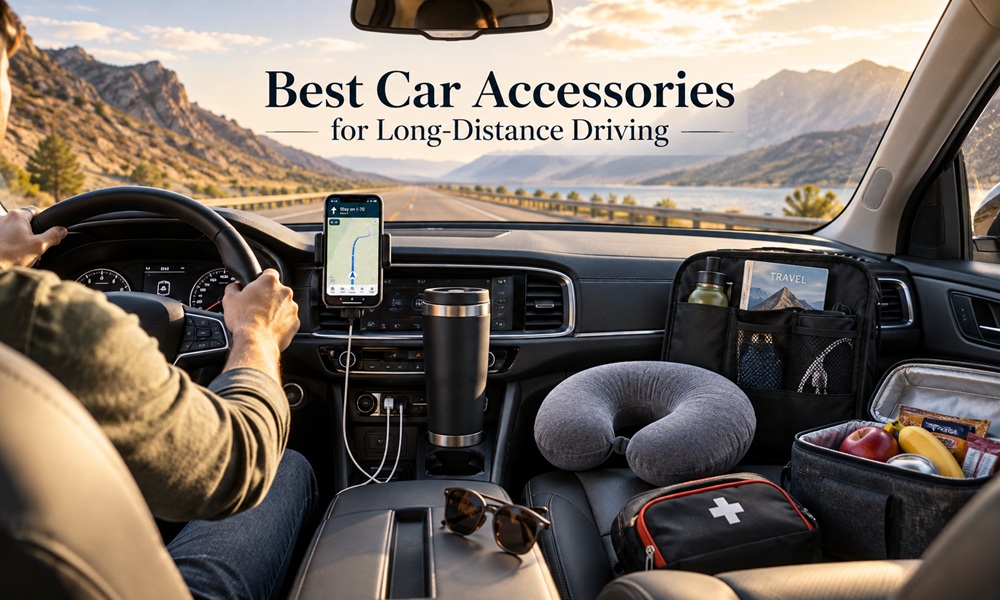
Five hours in, your lower back is done. Your phone is at 12%. And the nearest exit is 40 miles away.
Long drives expose every weakness in your car setup. A daily commute forgives a lot; a 600-mile day forgives nothing. The best car accessories for long-distance driving are the ones that solve a small problem before it becomes a real one.
This guide compares them across the three things that actually matter on a long drive: comfort, safety, and convenience. No filler. Each pick earns its spot, with a clear reason and a rough cost, so you can build the setup that fits your drive.
What Are the Most Important Car Accessories for Long Drives?
The ones that fight fatigue, keep you charged, and keep the cabin organized.
Long-distance driving stresses a car differently than errands do. Navigation runs for hours. Multiple devices drain at once. Luggage fights passengers for space. So the priorities shift.
Here is the short version, ranked by how much they change a long drive:
| Priority | Accessory | Problem it solves |
|---|---|---|
| Essential | Phone mount + car charger | Safe navigation, dead-battery panic |
| Essential | Lumbar / seat cushion | Back pain over long hours |
| Essential | Emergency + first-aid kit | Breakdowns far from help |
| High | Windshield sunshade | Heat and glare on long stops |
| High | Cooler bag + water | Fewer stops, staying hydrated |
| High | Backseat / trunk organizer | Cabin chaos on multi-day trips |
| Nice-to-have | Neck pillow, blanket | Passenger rest at stops |
| Nice-to-have | Dash cam | Evidence and peace of mind |
| Nice-to-have | Tablet holder | Keeps back-seat kids calm |
The pattern: comfort and safety come first, gadgets second. A phone dying mid-navigation ruins a drive faster than boredom does.
Which Comfort Accessories Reduce Fatigue on Long Drives?
The ones that fix your seating position and your temperature. Discomfort is not just unpleasant — it is a safety issue, because a sore, restless driver is a distracted one.
Comfort is the foundation. Here is what actually works over hours behind the wheel:
- Memory-foam seat cushion. Distributes weight, relieves pressure on the tailbone and hips, and adds a little height for better sightlines. Testers often describe a good one as an “adult booster seat” — in the best way.
- Lumbar support pillow. Straps to the seat and fills the gap your lower back is fighting all day. This is the single best fix for long-drive back pain, and it fits most cars.
- Heated / cooling seat cushion. Pulls double duty across seasons. One accessory handles sticky summer afternoons and cold winter mornings. Many plug into a USB or 12V port.
- Neck pillow and light blanket. Mostly for passengers, but drivers benefit during rest-stop naps.
- Polarized sunglasses. Underrated. They cut glare, reduce eye strain, and lower fatigue on bright highways.
- Compression socks. Odd-sounding but effective if you swell or stiffen on very long stints.
Unique insight: most “comfort” lists stop at the seat. The bigger fatigue lever is temperature and light. A cool cabin and low glare keep you alert far longer than an extra cushion does. Pair a cushion with a sunshade and good sunglasses, and you have a real anti-fatigue system.
What Car Accessories Improve Safety on Long-Distance Trips?
The ones that prepare you for two threats: breakdowns and drowsiness. One is mechanical. The other is human — and it is the deadlier of the two.
First, the human side, because the data is stark. According to the AAA Foundation for Traffic Safety, driver reaction time worsens measurably after about two hours of continuous driving. The National Safety Council cites estimates of roughly 6,400 deaths a year linked to drowsy driving, and notes that being awake more than 20 hours impairs you like a 0.08% blood-alcohol level. About 1 in 25 drivers admit to nodding off at the wheel within the past month.
No gadget replaces sleep and breaks. The rule of thumb from safety agencies: stop every 2 hours or 100 miles, and take a 15–20 minute nap if you feel sleepy. Traveling with a passenger roughly halves drowsy-crash risk, so share the wheel when you can.
That said, the right gear reduces the other risks:
- Emergency kit — jumper cables or a portable jump starter, tire inflator, warning triangle, flashlight, gloves.
- First-aid kit — pre-packaged is easiest, so nothing is missing.
- Portable jump starter — a dead battery on a remote road is a trip-ender without one.
- Tire inflator / TPMS — slow leaks are common on long hauls; catching pressure early prevents blowouts.
- Dash cam — evidence in a dispute, and many models now warn of drowsiness or lane drift.
- Reflective vest and a power bank — small, cheap, and genuinely useful if you are stranded.
Fatigue-fighting accessories worth a mention: a caffeine stash helps temporarily but is not a substitute for rest — the “crash” afterward can make drowsiness worse. A small robot companion or a good playlist keeps solo drivers engaged. Fresh air and a cool cabin help too.
Which Convenience Accessories Are Worth It for Road Trips?
The ones that solve power, navigation, and space — the three things that quietly derail long drives.
Power and navigation:
- Phone mount. Non-negotiable. Holding or glancing at a phone breaks focus; a mount keeps maps at eye level. Magnetic and cup-holder styles both work well.
- High-output car charger + long cable. A 6–10 foot cable reaches any seat. Multiple USB ports keep every device alive.
- Wireless CarPlay / Android Auto adapter. A newer upgrade that ditches the cable entirely and keeps navigation and music seamless.
- Power bank. Backup for when the car is off at a scenic stop.
Space and organization:
- Backseat / seat-back organizer. A place for everything — tablets, snacks, tissues, bottles — so nobody is digging through the footwell at 70 mph.
- Trunk organizer. Stops luggage and gear from sliding into chaos.
- Cooler bag. Keeps drinks and snacks cold, which means fewer stops and less fast food.
- Car trash can. Halfway through day one, the backseat becomes a landfill without one. This tiny item punches far above its price.
- Roof cargo box. For families or gear-haulers, it frees the cabin so comfort setups actually fit.
Entertainment (for the back seat):
- Tablet holder on the headrest. With nearly universal fit and anti-vibration mounts, these are the peace-keepers of family road trips.
How Do These Accessories Compare? (Quick Comparison Table)
Use this to decide what to buy first, based on your kind of trip:
| Accessory | Category | Rough cost | Best for | Skip if |
|---|---|---|---|---|
| Phone mount | Convenience | $ | Everyone | Your car has a great built-in screen |
| Lumbar pillow | Comfort | $ | Back pain, tall drivers | Short trips only |
| Seat cushion | Comfort | $$ | Long daily stints | You already have great seats |
| Emergency kit | Safety | $$ | Remote routes, winter | You never leave the city |
| Portable jump starter | Safety | $$ | Older batteries | New battery, always in coverage |
| Windshield sunshade | Comfort | $ | Hot climates, long stops | You always park in shade |
| Cooler bag | Convenience | $$ | Families, long hauls | Frequent food stops planned |
| Backseat organizer | Convenience | $ | Kids, multi-day trips | Solo minimalists |
| Dash cam | Safety | $$ | Everyone, honestly | Strict budget |
| Tablet holder | Convenience | $ | Family trips | No kids aboard |
$ = budget, $$ = mid-range, $$$ = premium. Prices vary widely by brand and features.
What Do Experienced Road-Trippers Say Is Overrated?
Not everything on the internet’s “must-have” lists earns its space. Seasoned drivers on road-trip forums are refreshingly blunt about it.
The recurring theme: buy for your actual routine, not the fantasy trip. A few honest takes worth internalizing:
- You do not need every gadget. The best setup is small and built around how you actually drive. Ten accessories crammed in a cabin defeats the comfort they promise.
- Cheap, boring items win. An extra-long charging cable, a car trash can, and a tissue box get praised more often than pricey gadgets.
- Novelty tech fades fast. Robot companions and mood lighting are fun, but they are not what makes a drive better — comfort, power, and organization are.
- Skip single-use bulk. If it only helps on one rare trip, borrow or rent instead of storing it year-round.
Underrated picks that regulars swear by: hand lotion in the door pocket, a cup-holder phone mount used every single day, and a simple seat-gap filler so your phone stops vanishing between the seats.
How Do You Choose the Right Accessories for Your Trip?
Match the gear to the drive. A solo highway sprint, a family vacation, and a multi-day camping haul need different kits.
A simple way to decide:
- Solo long-haul: prioritize the anti-fatigue system — cushion, sunglasses, sunshade, phone mount, charger, plus safety gear. Alertness is everything when no one can spell you.
- Family road trip: add backseat organization, tablet holders, a cooler, and a trash can. Managing the back seat is managing your stress.
- Camping / gear-heavy: a roof box or trunk organizer first, so the cabin stays livable. Then comfort.
- Winter or remote routes: load up on safety — jump starter, blankets, first-aid, and an inflator.
Build a small personal comfort kit — charger, water, tissues, snacks, sunglasses, lotion — and keep it together so you are never searching mid-drive. A prepared car makes long journeys feel dramatically easier.
Frequently Asked Questions
What are the best car accessories for long-distance driving? A phone mount, a strong car charger with a long cable, a lumbar or seat cushion, an emergency and first-aid kit, a windshield sunshade, and a backseat or trunk organizer. These cover comfort, safety, and convenience — the three things that shape a long drive.
How can I make long drives more comfortable? Fix your seating with a lumbar pillow or memory-foam cushion, control cabin temperature with a sunshade and heated/cooling cushion, cut glare with polarized sunglasses, and take a real break every two hours. Comfort keeps you alert, not just relaxed.
What safety accessories should I keep in the car for long trips? An emergency kit (jump starter, tire inflator, warning triangle, flashlight), a first-aid kit, a dash cam, and a power bank. Most importantly, plan breaks: stop every 2 hours or 100 miles, since reaction time drops sharply after two hours of continuous driving.
How often should I take breaks on a long drive? Every 2 hours or 100 miles as a baseline. Take a 15–20 minute nap if you feel drowsy, and longer breaks of 30–60 minutes every 4–6 hours on very long days. Caffeine helps briefly but does not replace rest.
Are dash cams worth it for road trips? For most drivers, yes. They provide evidence in disputes, and many models add drowsiness and lane-departure alerts — useful safety layers on long highway stints.
Do I really need all these accessories? No. Buy for your real driving habits. A solo highway driver, a family, and a camper need different kits. Start with the essentials — mount, charger, cushion, safety kit — then add only what your trips actually demand.