
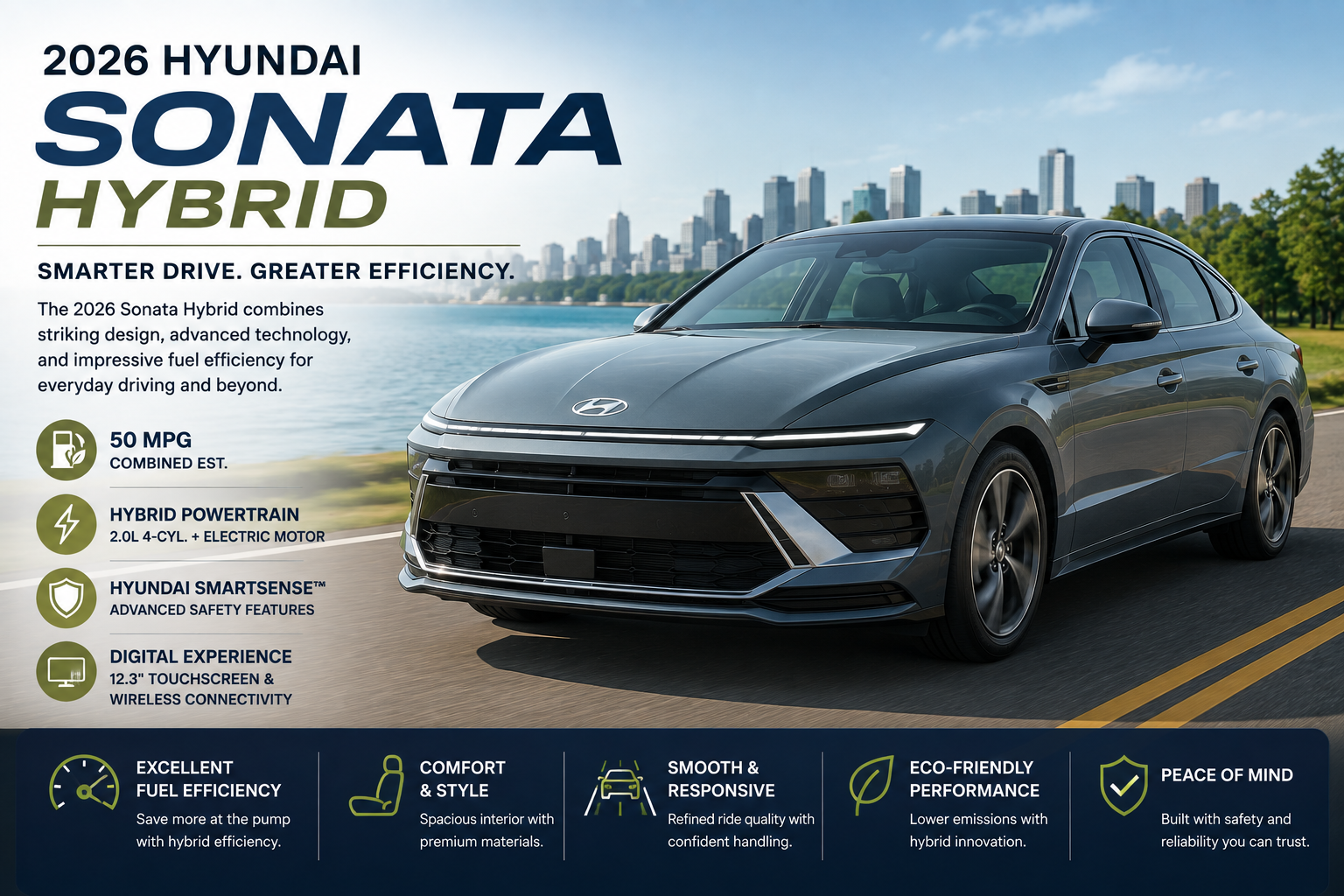
Blue, SEL, and Limited use the same 192-hp hybrid system, but their prices, MPG, comfort features, and ownership priorities are surprisingly different.
The 2026 Hyundai Sonata Hybrid is easiest to understand if you stop treating its three trims as a normal good-better-best ladder. They are really built for three different commuters.
The new Blue Hybrid is the mileage specialist. It reaches an EPA-estimated 51 mpg combined and starts only slightly above the gas Sonata SE. The SEL Hybrid gives up a few mpg in exchange for the equipment many daily drivers actually want, including heated seats, a power driver’s seat, wireless charging, rear air vents, and a panoramic sunroof. The Limited Hybrid keeps the same 47-mpg combined rating as the SEL but moves into near-luxury territory with leather, ventilated seats, a Bose audio system, a digital gauge cluster, surround-view cameras, and advanced parking technology.
For 2026, Hyundai’s current Sonata Hybrid specifications list three hybrid trims, all front-wheel drive and all using a 192-hp gas-electric powertrain with a conventional six-speed automatic transmission.
| KEY TAKEAWAYS
· Current Hyundai trim pages list the 2026 Sonata Blue Hybrid at $29,200, SEL Hybrid at $32,450, and Limited Hybrid at $38,250 before freight, tax, title, and license fees. · Blue Hybrid is the MPG leader at 47 city / 56 highway / 51 combined mpg. · SEL Hybrid and Limited Hybrid are rated at 44 city / 51 highway / 47 combined mpg. · Every 2026 Sonata Hybrid uses a 2.0-liter four-cylinder, a 39-kW electric motor, a lithium-ion battery, a six-speed automatic, and front-wheel drive. · The powertrain produces 192 combined horsepower. There is no AWD Sonata Hybrid for 2026. · Blue is the best choice for maximizing fuel savings, SEL is the strongest value for most commuters, and Limited is for buyers who prioritize premium technology and comfort. |
Three Commuters, Three Sonata Hybrids
Instead of starting with a long feature list, picture three owners driving the same basic car for very different reasons.
Commuter 1: “I Want the Lowest Fuel Bill Possible”
The Blue Hybrid is the obvious answer. Its 16-inch wheels, simpler equipment load, and efficiency-focused setup help it earn 47 mpg city, 56 mpg highway, and 51 mpg combined. That is unusually strong highway economy for a midsize sedan.
The Blue is not bare-bones. It still includes a 12.3-inch touchscreen, wireless Apple CarPlay and Android Auto, dual-zone automatic climate control, Smart Cruise Control with Stop & Go, blind-spot monitoring, lane-keeping assistance, LED headlights, and a hands-free smart trunk release.
What it leaves out is just as important. It does not get heated front seats, a power driver’s seat, a panoramic sunroof, wireless device charging, or the richer interior hardware found on the more expensive trims.
Best fit: high-mileage commuters, rideshare-style personal use, long freeway drives, and buyers who want hybrid efficiency without paying for luxury features.
Commuter 2: “I Want Comfort Without Spending Nearly $40,000”
The SEL Hybrid is the sweet spot for most buyers. It starts at $32,450 before freight and drops to 47 mpg combined, but the 4-mpg difference from Blue buys a long list of daily-use upgrades.
Hyundai adds a power driver’s seat with lumbar adjustment, heated front seats, heated side mirrors, acoustic front door glass, wireless phone charging, rear air vents, a leather-wrapped steering wheel, 17-inch eco-style wheels, and a panoramic sunroof.
Those changes make the SEL feel substantially more complete on a 30- to 60-minute commute. The cabin is quieter, winter mornings are easier, and the rear seat is more comfortable for passengers.
Best fit: families, mixed city/highway commuters, and buyers who care more about comfort per dollar than chasing the highest possible EPA number.
Commuter 3: “I Want a Near-Luxury Hybrid Without a Luxury Badge”
The Limited Hybrid is the technology-heavy option. At $38,250 before freight, it is much more expensive than Blue, but it bundles equipment that would require upper trims or option packages on many competitors.
Limited adds leather seating surfaces, ventilated front seats, a heated steering wheel, a 12.3-inch digital instrument cluster, a 12.3-inch touchscreen with navigation, Bose 12-speaker audio, Hyundai Digital Key 2 Premium, 64-color ambient lighting, a power trunk, rain-sensing wipers, rear sunshades, and additional parking technology.
Its driver-assistance package also expands with Highway Driving Assist, Blind-Spot View Monitor, Surround View Monitor, Remote Smart Parking Assist, and more comprehensive parking sensors.
Best fit: buyers downsizing from a luxury sedan, commuters who spend hours in traffic, and anyone who values cameras, parking assistance, seat comfort, and cabin technology more than the last 4 mpg.
How Much Does the 2026 Sonata Hybrid Cost?
Hyundai’s current U.S. trim pages show the following starting MSRPs before freight. Hyundai’s online pricing can be updated during a model year, so buyers should confirm the final window sticker rather than relying on older launch pricing.
| Trim | Starting MSRP* | Combined MPG | Main Mission |
| Blue Hybrid | $29,200 | 51 mpg | Efficiency |
| SEL Hybrid | $32,450 | 47 mpg | Value and comfort |
| Limited Hybrid | $38,250 | 47 mpg | Luxury and technology |
*MSRP figures shown exclude freight, taxes, title, license fees, dealer-installed accessories, and any market adjustments.
The Blue Hybrid is especially interesting because its current base price is only about $1,750 above the gas-only Sonata SE. The gap to SEL Hybrid is $3,250, while Limited costs another $5,800 over SEL.
That creates a clear decision point. Blue asks whether fuel economy is your priority. SEL asks whether comfort is worth a modest price increase. Limited asks whether you would otherwise buy a more expensive near-luxury sedan.
What MPG Does the 2026 Sonata Hybrid Get?
The efficiency numbers split the lineup into two groups.
| Trim | City MPG | Highway MPG | Combined MPG |
| Blue Hybrid | 47 | 56 | 51 |
| SEL Hybrid | 44 | 51 | 47 |
| Limited Hybrid | 44 | 51 | 47 |
Blue’s 56-mpg highway rating is the eye-catching figure, but 51 mpg combined is the more useful number for ownership planning. SEL and Limited still return an excellent 47 mpg combined.
Real-world testing has also been encouraging. Car and Driver’s 2026 Sonata coverage notes that the last Sonata Hybrid tested on its 75-mph highway fuel-economy route returned 51 mpg. Car and Driver also lists a 7.8-second 0-to-60-mph result for the hybrid, which puts performance in the normal family-sedan range rather than the slow-car category.
What Does the MPG Difference Cost in Real Money?
A 4-mpg difference sounds significant, but its dollar impact depends on how much you drive.
At 12,000 miles per year, a 51-mpg Blue Hybrid uses about 235 gallons. A 47-mpg SEL or Limited uses about 255 gallons. At an illustrative gasoline price of $3.50 per gallon, the difference is about $70 per year.
At 20,000 miles, the difference grows to roughly $116 per year at the same fuel price.
| Annual Driving | 51 MPG Blue | 47 MPG SEL/Limited | Approx. Difference |
| 12,000 miles | About $824 | About $894 | About $70 |
| 15,000 miles | About $1,029 | About $1,117 | About $88 |
| 20,000 miles | About $1,373 | About $1,489 | About $116 |
The implication is important: buyers should not choose Blue purely to save fuel unless they also prefer its lower purchase price and simpler equipment. The annual gasoline savings alone will not recover a large trim-price difference quickly.
How Does the Hybrid System Drive?
All three trims combine a 2.0-liter gasoline four-cylinder with a 39-kW electric motor for 192 combined horsepower. Hyundai uses a six-speed automatic instead of the continuously variable transmission commonly found in hybrids.
That changes the character of the car. You feel actual gear changes under acceleration, which can make the Sonata feel more conventional than a hybrid with an e-CVT. The downside is that transitions between gasoline and electric operation are sometimes more noticeable than in the smoothest rival systems.
The electric motor produces its strongest torque from zero rpm, so initial response in normal traffic is good. The car is not tuned as a sport sedan, but it has enough power for merging, highway passing, and carrying four adults without feeling strained.
Front-wheel drive is standard and the only drivetrain offered on the hybrid. If AWD is a requirement, the gas Sonata SEL Sport offers it, while the Toyota Camry Hybrid is available with electronic AWD.
Is the Blue Hybrid Really the Best Highway Commuter?
For pure fuel economy, yes. The 56-mpg EPA highway rating gives the Blue an unusually strong advantage for drivers who cover long distances at moderate highway speeds.
Its 13.2-gallon tank also means the theoretical highway distance between fill-ups can be very long. Actual range will be lower because drivers do not use every gallon, and speed, wind, weather, elevation, tire pressure, and traffic all affect fuel use.
The Blue’s tradeoffs become obvious on long commutes, however. It lacks heated seats, rear air vents, wireless charging, and the acoustic front door glass fitted to SEL and Limited. A buyer spending two hours per day in the car may reasonably decide that SEL’s comfort is worth more than a few extra gallons of gasoline per year.
What Is the Cabin Like for Daily Use?
The Sonata’s cabin is one of the main reasons to choose it over a compact hybrid. Hyundai gives the car a 111.8-inch wheelbase and a wide, low dashboard that makes the front row feel open.
The 12.3-inch center touchscreen is standard across all three hybrid trims, and wireless Apple CarPlay and Android Auto are included. Hyundai also uses a column-mounted electronic shifter, which frees up room in the center console.
Cargo space is roughly 16 cubic feet, competitive for a midsize sedan. The rear seatbacks fold 60/40, making it easier to carry long items.
One weakness is rear legroom compared with the roomiest rival sedans. The Sonata is comfortable for adults, but buyers who routinely carry tall passengers in back should compare it directly with the Honda Accord before purchasing.
Which Safety Features Are Standard?
The 2026 Sonata Hybrid starts with a strong driver-assistance package even in Blue.
- Forward Collision-Avoidance Assist with pedestrian, cyclist, and junction-turning detection.
- Lane Keeping Assist and Lane Following Assist.
- Smart Cruise Control with Stop & Go.
- Blind-Spot Collision Warning.
- Rear Cross-Traffic Collision-Avoidance Assist.
- Safe Exit Warning.
- Driver Attention Warning.
- High Beam Assist.
Limited adds the features that change how the car feels in dense traffic and parking lots. Blind-Spot View Monitor displays a camera image when the turn signal is activated, Surround View Monitor provides a top-down parking perspective, Highway Driving Assist combines adaptive cruise and lane-centering functions, and Remote Smart Parking Assist can move the vehicle in or out of certain parking spaces while the driver is outside the car.
How Does the Sonata Hybrid Compare With the Camry Hybrid?
The 2026 Toyota Camry is hybrid-only and starts at $29,600 according to Toyota’s current U.S. site. It offers up to 51 mpg combined and up to 232 net combined horsepower with available electronic AWD.
That creates an interesting split. The Sonata Blue can match the Camry’s best combined efficiency while delivering a much higher 56-mpg highway rating, but the Camry offers more power and the option of AWD.
The Sonata’s strongest counterargument is equipment. Hyundai tends to package comfort and camera technology aggressively, especially in the Limited. Buyers should compare exact trims rather than assuming one model is universally the better value.
How Does the Sonata Hybrid Compare With the Accord Hybrid?
Honda lists the 2026 Accord Hybrid from $33,795. The most efficient EX-L Hybrid is rated at 48 mpg combined, while other Accord Hybrid trims are generally rated lower because of larger wheels and sportier equipment.
The Accord has the advantage in chassis polish, rear-seat space, and overall driving refinement. The Sonata counters with a much lower entry price in Blue, a longer list of available parking and convenience technology, and the 51-mpg combined Blue rating.
For a buyer focused on ride and handling, the Accord remains the benchmark. For a buyer focused on feature value and warranty coverage, the Sonata deserves equal attention.
What Warranty Coverage Comes With the Sonata Hybrid?
Warranty coverage is one of Hyundai’s clearest ownership advantages.
Hyundai lists a 5-year/60,000-mile new-vehicle limited warranty, a 10-year/100,000-mile powertrain limited warranty for the original owner, and 5 years of unlimited-mile roadside assistance. The hybrid battery and specified hybrid-system components carry 10-year/100,000-mile coverage under Hyundai’s published U.S. warranty terms.
That battery coverage is particularly relevant to buyers who plan to keep the car for a long time. As with any warranty, exclusions and ownership-status rules apply, so shoppers should read the current warranty handbook rather than relying only on marketing summaries.
Which 2026 Sonata Hybrid Should You Buy?
Buy Blue Hybrid if…
You want the lowest purchase price, drive a lot of highway miles, value 51 mpg combined, and do not care about a sunroof, heated seats, or premium interior features.
Buy SEL Hybrid if…
You want the best overall balance. The SEL’s heated seats, power driver adjustment, rear vents, acoustic glass, wireless charging, panoramic roof, and 17-inch wheels are useful every day. For many buyers, this is the trim that makes the strongest case.
Buy Limited Hybrid if…
You want the Sonata to replace a more expensive premium sedan. The 47-mpg rating is still excellent, while leather, ventilated seats, Bose audio, the digital cluster, cameras, Highway Driving Assist, and parking technology make the cabin feel far more upscale.
Frequently Asked Questions
What is the 2026 Hyundai Sonata Hybrid MPG?
The Blue Hybrid is rated at 47 mpg city, 56 mpg highway, and 51 mpg combined. SEL Hybrid and Limited Hybrid are rated at 44 city, 51 highway, and 47 combined.
How much does a 2026 Sonata Hybrid cost?
Hyundai’s current U.S. trim pages list Blue Hybrid at $29,200, SEL Hybrid at $32,450, and Limited Hybrid at $38,250 before freight and other fees.
Does the 2026 Sonata Hybrid have AWD?
No. All three 2026 Sonata Hybrid trims are front-wheel drive. Buyers who need AWD must choose another Sonata powertrain or a different hybrid sedan such as an AWD Toyota Camry.
How much horsepower does the Sonata Hybrid make?
The 2.0-liter gas engine and electric motor produce 192 combined horsepower.
Does the Sonata Hybrid use a CVT?
No. Hyundai uses a six-speed automatic transmission in the Sonata Hybrid rather than a conventional belt-type CVT.
Which Sonata Hybrid trim gets the best MPG?
The Blue Hybrid. Its smaller 16-inch wheels and efficiency-focused configuration help it achieve 51 mpg combined, compared with 47 mpg for SEL and Limited.
Is the 2026 Sonata Hybrid good for long trips?
Yes. It combines excellent highway fuel economy, a 13.2-gallon tank, supportive front seats, a large touchscreen, and a comfortable ride. SEL and Limited are better equipped for long-distance comfort than Blue.
The Bottom Line
The 2026 Hyundai Sonata Hybrid works because the three trims have distinct jobs. Blue is not merely the cheapest version. It is the fuel-economy specialist, with a 51-mpg combined rating and a price close to many non-hybrid midsize sedans. Limited is not merely the expensive version. It is Hyundai’s answer for buyers who want premium technology without moving into a luxury brand.
For most people, though, the SEL Hybrid is the smart middle. Its 47-mpg combined rating is still excellent, and the features it adds are the ones commuters notice every day: heated seats, a power driver’s seat, rear air vents, acoustic glass, wireless charging, and a panoramic sunroof.
If you drive enough miles for fuel economy to dominate every other concern, choose Blue. If you want the best everyday value, choose SEL. If you want cameras, ventilated seats, premium audio, and near-luxury convenience, choose Limited. The underlying hybrid system is the same, so the real decision is not about performance. It is about what makes your daily commute easier.
Pricing and specifications were checked against current U.S. manufacturer information available in August 2026. Hyundai pricing shown on different site modules can update at different times, so always confirm the current window sticker and freight charge with the selling dealer. Fuel-cost examples use $3.50 per gallon only for illustration. Actual MPG and ownership costs vary.